Category: Bias

Mormonism’s Moment?

By , February 10, 2011 8:58 am

Is the time ripe for a Mormon to be President, or will religion get in Mitt Romney’s or Jon Huntsman Jr.’s way? Sally Quinn asks the question in On Belief, her religious bailiwick at The Washington Post. Eight panelists, including the likes of Barry Lynn who writes,

There really is only one question that needs to be answered: can you faithfully execute the laws of the United States or is there some religious view you hold that you believe transcends that duty?

Which begs the question: Would he, or anyone else, accept the answer, “Yes, I can,” and move on? Or would that question actually be an open door through which the inquisitor would parade his even deeper-held beliefs that “there ain’t no way a Mormon President won’t do the bidding of his (or her) hierarchical superiors in Salt Lake!”

I’ll be back for further comment on this subject.

Political Bias in Academia. Conservatives Hardest Hit.

By , February 9, 2011 2:55 pm

Veronique de Rugy, an economist at George Mason University, has a post at The Corner on bias an academia. This paragraph captures the essence:

“Anywhere in the world that social psychologists see women or minorities underrepresented by a factor of two or three, our minds jump to discrimination as the explanation,” said Dr. Haidt, who called himself a longtime liberal turned centrist. “But when we find out that conservatives are underrepresented among us by a factor of more than 100, suddenly everyone finds it quite easy to generate alternate explanations.”

Looking for the Editorial Where the Times Criticized Democrats for Exploiting a Crisis

By , February 7, 2011 9:23 am

As states groan and stumble through the recession, some politicians are trying to exploit their financial crises for ideological purposes.

New York Times editorial, February 7, 2011

Nicholas Kristof Plays Edgar Bergen to His Egyptian Friend, Charlie McCarthy

By , February 6, 2011 1:24 pm

Where’s a friend, when you need a someone to bash Republicans. Civility being the rage and all in the United States, you go to Egypt, which is what New York Times columnist Nicholas Kristof did when he reached out to “an old friend in Cairo” to reassure him that Egypt would not fall into the hands of the Muslim Brotherhood if Mubarak exited stage right. That woman,

a woman with Western tastes that include an occasional glass of whiskey, . . . thought for a moment and said: “Yes, possibly. But, from my point of view, in America the Republican Party is bad for peace as well.”

But don’t stop there Nick, go for the throat–in your very next sentence,

If democracy gains in the Middle East, there will be some demagogues, nationalists and jingoists, just as there are in America and Israel, and they may make diplomacy more complicated.

I think this is what is called a tri-fecta: 1.) use a mouthpiece to bash your least favorite political party, 2.) make sure that bashing includes equating the Republican party with the Muslim Brotherhood, 3.) then make sure to chime in that there are “demagogues, nationalists, and jingoists” in American, just like those horrible Muslim Brotherhood guys who are busy making “diplomacy more difficult” (for the anointed one, I suppose).

Whatever.

Update: Stumbled upon this post by David Pryce-Jones, Anyone Here Been Raped & Speaks English? a post named after the book of the same title. Seemed an appropriate addendum.

Religion in the Public Square

By , February 5, 2011 11:13 am

Elder Dallin H. Oaks recently gave a speech on religious freedom at Chapman University School of Law. He also gave an interview on the subject. Both are worthy–very worthy–of our attention.

<iframe title=”YouTube video player” width=”640″ height=”390″ src=”http://www.youtube.com/embed/XWGtR9xf9Xs” frameborder=”0″ allowfullscreen></iframe>

A little background on Elder Oaks, currently an Apostle in The Church of Jesus Christ of Latter-day Saints. Elder Oaks graduated from the University of Chicago School of Law; clerked for Earl Warren, then Chief Justice of the Supreme Court; taught at Chicago; and served as interim dean of that law school, as president of BYU (where he also oversaw the establishment of the J.Reuben Clark Law School), and finally a justice on the Utah Supreme Court. He was considered for the U.S. Supreme Court by both President Ford and Reagan.

In his speech, Oaks gives a number of troubling examples of what he is concerned about and why he is calling for religions to join together in protecting religion’s place in the public square:

In New Mexico, the state’s Human Rights Commission held that a photographer who had declined on religious grounds to photograph a same-sex commitment ceremony had engaged in impermissible conduct and must pay over $6,000 attorney’s fees to the same-sex couple. A state judge upheld the order to pay. In New Jersey, the United Methodist Church was investigated and penalized under state anti-discrimination law for denying same-sex couples access to a church-owned pavilion for their civil-union ceremonies.  A federal court refused to give relief from the state penalties. Professors at state universities in Illinois and Wisconsin were fired or disciplined for expressing personal convictions that homosexual behavior is sinful. Candidates for masters’ degrees in counseling in Georgia and Michigan universities were penalized or dismissed from programs for their religious views about the wrongfulness of homosexual relations. A Los Angeles policeman claimed he was demoted after he spoke against the wrongfulness of homosexual conduct in the church where he is a lay pastor. The Catholic Church’s difficulties with adoption services and the Boy Scouts’ challenges in various locations are too well known to require further comment. (see sources in transcript)

As Elder Oaks made his case that we–religious believers–need to stand up and speak out, I was particularly impressed by his quotation of his fellow Apostle, the late Neal A. Maxwell:

My esteemed fellow Apostle, Elder Neal A. Maxwell, asked:

“[H]ow can a society set priorities if there are no basic standards? Are we to make our calculations using only the arithmetic of appetite?”

He made this practical observation:

“Decrease the belief in God, and you increase the numbers of those who wish to play at being God by being ‘society’s supervisors.’ Such ‘supervisors’ deny the existence of divine standards, but are very serious about imposing their own standards on society.”

Elder Maxwell also observed that we increase the power of governments when people do not believe in absolute truths and in a God who will hold them and their government leaders accountable.

Don’t Mind Us. We’re Just Here to Cook for You.

By , February 2, 2011 10:28 am

New York Times food critic Mark Bittman has a post up titled A Food Manifesto for the Future–the word manifesto is particularly apt–in which he attempts to set our tables in the future. What we eat; where and how it’s grown or raised; and whether it’s processed, subsidized, or advertised are all of concern to him. More importantly–and because he really has little or no power–he thinks it ought to be the concern of government, though he is careful to caution that

This isn’t nanny-state paternalism but an accepted role of government: public health. If you support seat-belt, tobacco and alcohol laws, sewer systems and traffic lights, you should support legislation curbing the relentless marketing of soda and other foods that are hazardous to our health — including the sacred cheeseburger and fries.

No, Mr. Bittman, one doesn’t follow the other; furthermore, if I accept your premise, where does the other end? If I accept sewer systems, should I also be okay with my government controlling what I read, listen to, or watch? After all, for example, your paper has drawn a straight line from Sarah Palin, right-wing talk radio, and the Tea Party to Tuscon, and we certainly don’t want any more of that nasty business.

Anyway, Mr. Bittman’s laundry list of things he’d like to prohibit or subsidize reads like a page from the rules implementing the Communist Manifesto (parentheticals are mine):

-End government subsidies to processed food. (Hey, I’m fine with that.)
. . .
-Begin subsidies to those who produce and sell actual food for direct consumption. (Oh, I see. He’s not against subsidies; he’s against subsidies he doesn’t like. Never mind.)
. . .
-Outlaw concentrated animal feeding operations. (I’m on the bandwagon again!)
. . .
-Encourage the development of sustainable animal husbandry. (I’m beginning to detect a pattern here.)
. . .
-Encourage and subsidize home cooking. (A very distinct pattern.)

Mr. Bittman goes on and on and on, but you get the idea. I also get the idea that he reads from the same playbook Al Gore uses. Bittman writes,

It’s difficult to find a principled nutrition and health expert who doesn’t believe that a largely plant-based diet is the way to promote health and attack chronic diseases . . . (emphasis mine)

Note the word principled. It’s purpose in that sentence can best be understood through substition:

It’s difficult to find a nutrition and health expert I agree with who doesn’t believe that a largely plant-based diet is the way to promote health and attack chronic diseases . . . (emphasis mine again)

And that substitution illustrates perfectly Mr. Bittman’s approach to food in our lives. He doesn’t like who’s picking the winners right now, so he wants new ‘pickers,’ a bias he betrays in one more bullet point on his list of winners and losers:

-Break up the U.S. Department of Agriculture and empower the Food and Drug Administration.

There, he says to himself in a very self-satisfied way, that will fix it. My elites will do much better than that last batch of elites.

I agree wholeheartedly with one item on his bulleted list, though I might disagree with him on how the idea is implemented:

-Mandate truth in labeling. Nearly everything labeled “healthy” or “natural” is not. It’s probably too much to ask that “vitamin water” be called “sugar water with vitamins,” but that’s precisely what real truth in labeling would mean.

I’m all for more information, as long as we leave it at that and let the masses in the market decide what to do with that information. I’m also all for eliminating subsidies–totally. Shifting them from one set of winners to another doesn’t cut it.

I’m going to continue monitoring the Food Czar at The New York Times, if for no other reason than to make sure I get to read the rest of the story behind this little teaser:

(Someday soon, I’ll write about my idea for a new Civilian Cooking Corps.)

I can’t wait!! Visions of fair-skinned culinary school graduates dressed in lederhosen are dancing in my head as I write.

Can it be? We’ll have to wait and see. But right now I have to cook breakfast.

Pot Misrepresented By Kettle

By , February 1, 2011 5:57 pm

In my last post, I noted that I hadn’t read much by or about Al Gore lately; he’d apparently taken a breather from his climate-change crusades, I assumed, because of that little matter in The National Enquirer or maybe he was busy decorating his new home in California. But then I read some of his blog and discovered that he’s been a relatively regular poster. I also learned that the guy spins faster than a top. To wit:

In a December 15, 2010 post titled Fox News Manipulates Climate Coverage, he writes,

Fox News has consistently delivered false and misleading information to its viewers about the climate crisis.

His evidence?

Today, Media Matters posted an alarming email sent by Bill Sammon, the Washington, DC, managing editor at Fox News. Sammon sent the email to Fox News producers on December 8, 2009 – just as the Climate Conference in Copenhagen was beginning:

“Subject:Given the controversy over the veracity of climate change data”
“we should refrain from asserting that the planet has warmed (or cooled) in any given period without IMMEDIATELY pointing out that such theories are based upon data that critics have called into question. It is not our place as journalists to assert such notions as facts, especially as this debate intensifies.”

And why is this misleading? Apparently because Al says so:

But there’s no legitimate debate: the planet is warming. Moreover, man-made global warming pollution is the principal cause.

No legitimate debate. Bias. Deniers. In my business–I write and teach writing, among other things–such words, used the way Gore and his acolytes use them, fall under the umbrella of logical fallacies. In other words, their purpose is to mislead your audience by mislabeling, misrepresenting, and denigrating your opponents without actually responding to their arguments. In short, they come in handy when you’re spinning.

Beck v. Piven: No, Bruce Bartlett is the Idiot

By , January 24, 2011 10:05 am

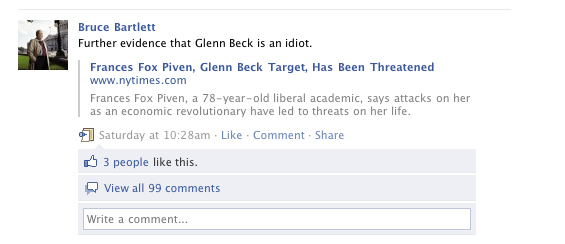
I really was going to write about this, honest. Just couldn’t get to it until today. But given that the controversy has been written about extensively already, I’ll just note the following: the Facebook Post that prompted me to want to write about Beck v. Piven in the first place.

On Saturday, my Facebook “friend,” Bruce Bartlett, wrote “More evidence that Glenn Beck is an idiot.”

As you can see, the post linked to Brian Stetler’s New York Times piece in which Stetler attempts to draw a straight line from Beck’s discussion of Piven on his program to the alleged threats Piven claims to be receiving. Unfortunately for Stetler’s theory–or at least Piven’s–that line may run through a variety of Conservative Web sites, including one or more operated by Andrew Breitbart–a fact reported in paragraph 14 of Stetler’s story.

As I read Bartlett’s Facebook post and the underlying story, my first thought was: and your point is?

You write something. Someone else reads it and holds you to it, and I’m supposed to rally around your flag? When I write, I’m always hoping someone will read it. My suggestion? Frances, don’t get mad. Get even. Monetize this opportunity.

And back to Bartlett, a protege of the late Jude Wanniski. From Bartlett’s many Facebook posts decrying the Tea Party, Conservatives, etc. I’m beginning to think he’s becoming unhinged. Woudn’t want that to get around.

Edited: to clarify and to correct a couple of typos pointed out by a (my only?) reader.

“I only know one person who voted for Nixon,” Pauline Kael*

By , January 23, 2011 9:53 pm

And I’ll bet she never knew even a single Mormon. Based on Sally Quinn’s question to Mormon historian and Columbia history professor emeritus Richard Bushman, it’s a safe bet Sally hasn’t. Regardless, she’s a rather credulous journalist practicing a supposedly cynical and skeptical profession if her questions and musings on Mormonism are any indication.

In a Pew Forum on Religion and Public Life almost four years ago titled Mormonism and Politics: Are They Compatible? she first asks Bushman–a rather famous Mormon historian–if he’s a Mormon. When he responds yes, she responds, “I’m sure you have heard of Martha Beck.” Again, the answer is yes. After reviewing briefly who Beck is, for the benefit of people in attendance who may not have heard of her, and after mentioning Beck’s then-recent book Leaving the Saints,”** Quinn says,

[Beck] went back [to Brigham Young University] and had an absolutely horrendous experience. She wrote another book called Leaving the Saints. She finally did leave the church. In her book, she revealed that her father had sexually abused her when she was a child. She talked about how she went back, and she had this Ph.D. from Harvard, and she was trying to fit in and bring her child into it, but she went to work as a teacher at Brigham Young University and found that the church was very unaccepting, very dogmatic, and that she couldn’t teach what she wanted to teach. Because she spoke out against some of the beliefs, she was in effect banned or banished from the church, she and her husband. Finally, they actually had to move away to Arizona because it became so untenable a situation.

And I think that reading a book like that – I have no knowledge of Mormons at all, really, but reading Martha’s books, I was absolutely appalled at some of the things that I read about the Mormon Church and the closed-mindedness and demands on people that they adhere to the beliefs or they will get banished.

So I think that kind of story is where a lot of these perceptions come from. I don’t know whether every word she wrote was true or not. It sounded pretty true. I think that sets the stage for my next question, which is, How Mormon is Mitt Romney? I mean, is he someone who would adhere to all of the beliefs of the church? In Martha Beck’s case, when she went against church policy, she was banned or banished. Would that happen if Romney disagreed with the church, and particularly their positions on women? (all bolded emphasis supplied)

These statements from a journalist and co-founder of the Washington Post’s On Faith “feature,” are revealing, especially in the context the of On Faith’s mission statement, a statement written by Quinn and co-founder Jon Meacham:

Religion is the most pervasive yet least understood topic in global life.

Maybe even at The Washington Post.

From the caves of the Afghan-Pakistan border to the cul-de-sacs of the American Sunbelt, faith shapes and suffuses the way billions of people-Christian, Muslim, Jewish, Hindu, Buddhist, and nonbelievers-think and act, vote and fight, love and, tragically, hate. It is the most ancient of forces. As Homer said, “All men need the gods.” Even the most ferocious atheists find themselves doing intellectual battle on a field defined by forces of the faithful.

Seems as though Quinn and Meacham have pretty much staked out the religious terrain, which, according to them, runs from caves to cul-de-sacs. That pretty much leaves out L.A., New York City, D.C., Paris, London, and any other place where sophisticates gather to help the rest of us “understand” the “least understood topic in global life,” especially, it appears, if that topic is Mormonism.

And so, in a time of extremism — for extremism is to the 21st century what totalitarianism was to the 20th — how can people engage in a conversation about faith and its implications in a way that sheds light rather than generates heat?

And Quinn’s very uninformed opinion of Beck’s book? What kind of light does it shed?

At The Washington Post and Newsweek, we believe the first step is conversation-intelligent, informed, eclectic, respectful conversation-among specialists and generalists who devote a good part of their lives to understanding and delineating religion’s influence on the life of the world. The point of our new online religion feature is to provide a forum for such sane and spirited talk, drawing on a remarkable panel of distinguished figures from the academy, the faith traditions, and journalism. Members of the group will weigh in on a question posed at least once a week, perhaps sometimes more often, depending on the flow of the news. We encourage readers to join the conversation by commenting on what our panelists have to say, offering their own opinions and suggesting topics for future discussions.

From the nature of evil to religious reformation, from the morality of fetal stem-cell research to the history of scripture, from how to raise kids in multi-faith households to the place of gays in traditional churches — of the asking of questions, to paraphrase Ecclesiastes, there shall be no end. We think that the online world, with its limitless space, offers us a unique opportunity to carry on a fruitful, intriguing, and above all constructive conversation about the things that matter most.

Blah, blah, blah, blah. If Quinn’s knowledge of Mormonism says anything about her knowledge of religion in general, this “feature” is in trouble. If Quinn’s lack of research before she participated in that Pew Forum on Mormonism is any indication of her work ethic and research skills, I have to wonder about The Washington Post, given her station and tenure there. If her credulity with regards to Beck’s book is any indication, she’s not skeptical enough to be a good journalist.

*Quoted by Israel Shenker, “Critics Here Focus on Films As Language Conference Opens,” The New York Times (1972-12-28).

**By the way, if you’re interested in how horrible Beck’s book is, go here. It’s really, really, really bad.

Pravda West?

By , January 21, 2011 11:24 am

This morning, as I drove to meet my brother and sister-in-law for breakfast, NPR’s Morning Edition treated me to a teaser lead-in to a story that taxpayers were soon going to get back all the money the government had invested in AIG during the bailout. The actual story (which I cannot find online) confirmed the headline, though it sort of hedged with words like “depending on stock performance” and such.

I own shares in AIG. Prior to the bailout, I owned 20 Xs more shares–but that’s another story. Point is, I watch the stock and news about the stock. And I watched recently as the share price climbed above $52 a share on January 7 (I bought those shares at the reverse split-adjusted price of $43.60 on 9/18/08). Since that high, the share price has fallen precipitously to just over $42.00 as I write, almost a 20% decline in two weeks. In other words, I’m worse off than when I bought the shares over three years ago. So exactly how are the taxpayers getting paid back–soon–if the market value of AIG has decreased? I understand that the government and/or AIG may sell off operating companies and repay the debt from the proceeds. Do the value of the parts exceed the value of the whole?

Or is this more Prava-like reporting of the sort that the Seattle Times debunked this morning? Referring to the White House’s recent announcement of $19 billion in new Boeing jet orders, an announcement timed to coincide with the visit of Chinese President Hu Jintao, reporter Dominic Gates writes,

The deal President Hu signed does not include any new jet orders.

Delivering the formal approval during Hu’s visit is designed to make the Chinese government appear responsive to U.S. concerns about the balance of trade.

However, all of the airplanes in the sale were announced and booked by Boeing as firm orders over the past four years. Chinese airlines had already paid nonrefundable deposits and signed contracts for the jets, most of them as far back as 2007.

Gates continues,

The White House announcement said the total value of the orders was $19 billion.

But that’s the list price, which airline customers never pay.

Based on market data from aircraft-valuation consultancy Avitas, the actual price for those 200 planes is about $11 billion.

To be fair, Gates points out that Boeing says that the Chinese government’s approval is important, but . . .

Summing up the deal, Gates closes with,

Our verdict: The Chinese orders are real and will help keep Boeing workers busy here through 2013. Still, the White House announcement, while technically true, left a completely false impression.

The orders weren’t new. They weren’t really worth $19 billion. And Boeing isn’t soaring ahead of its big global rival with this deal.

An accurate headline for the news might have said: Hu finally signs off on old orders for U.S. jets, but Boeing still lags Airbus in China.

Likewise, an accurate lead-in for the AIG story on NPR might have said: Taxpayers will recoup their investment in AIG if the stars align and the stock price ever gets high enough, but that’s far off in the future.

Update: I found a Reuters story that I think the NPR story was based on. The three nut paragraphs:

In its third report on the bailout of AIG, the GAO said U.S. taxpayers’ risk exposure to the insurer increasingly is expected to be tied to the success of AIG and its value as seen by investors in the company’s common stock.

“The government’s ability to fully recoup the federal assistance will be determined by the long-term health of AIG,” the report said.

A Treasury official said taxpayers were in a strong position to recover “every dollar put into AIG.” (emphasis supplied)

I’m virtually certain the two quotes appeared in the NPR story. The second quote resembles the NPR headline. Alert readers will notice that the first quote basically takes all the zing out of the second, and thus the headline of the NPR story.

Panorama Theme by Themocracy