Category: Law

Chick-fil-Lessons

By , August 1, 2012 10:32 pm

So what do we learn from the recent Chick-fil-A controversy and protests? Well,we learn that

1. We’ve turned 1/6th of our economy over to people who think it’s fine and dandy to use the considerable power of government to shut down speech they personally don’t approve of;

2. Many on the left has no scruples about maligning the right’s motives;

3. The Tea Party and other like-minded people will be out in force on Election Day (below, the line today at Chick-fil-A in Orem, Utah);

4. And thankfully, some on the left still believe in free speech.

About that free speech thingy, go here and read what the Volokh Conspiracy of law professors has to say about it. Eugene Volokh is one of the nation’s top Constitutional law scholars.

UPDATE: The author of the Facebook rant referred to in #2 pulled his post.

Follow the Power

By , July 13, 2012 9:07 pm

Why does money always get the bad rap, while power–at least the power coveted by those in government–is almost always benign? You know the mantra: If you want to find out who did the dirty deed, it’s always follow the money, never the power. It’s what Woodward claims Deep Throat told him in that garage in Washington D.C., and it’s been repeated ad nauseam ever since. But let me ask you: wouldn’t a quicker route to solving the Watergate mystery have been to follow the power? Who benefited from the break-in? Well, Nixon, of course. And who ended up resigning because of his abuse of power? Nixon again.

Power in government comes almost inevitably to those who first offer you something. They offer to fix your schools. The say they can clean up the environment. Need healthcare? They’re on your doorstep. The list goes on. And yes, they often come through on their offers. We get cleaner water and a safety net. It’s not all bad. Never is. And in any case, your personal cost for anything the offeror does is often obscured by the good deed. But don’t kid yourself; there is a cost. After the transaction, you have less power, and the government that solved (or tried to solve) your problem has more.

In my mind, power is at least as corrupting as money–and in the wrong hands, much more worrisome. For me, the wrong hands are the hands of people I can’t simply walk away from. Thus, though my church may be powerful in some sense, it’s not power I fear because I can walk away from it. Likewise, I’m not too concerned about the power of a G.E. or an ExxonMobile because I can drive across the street and buy from Sears or Texaco. And it’s not power in the hands of the governor or legislature of my state because it’s pretty easy to move to another state.

No, the power I fear most is power in the hands of the federal government because it’s not so easy to leave the United States of America. That takes more money, a passport, and the proper visas. It takes a dislocation of family and friends, of employment, of language, and so on. Besides, if power in the hands of the federal government has reached a point that I would want to move, it’s likely that I may not be able to move in any case.

Now don’t misunderstand; I don’t think we’re anywhere close to that in the U.S. But I do think it’s time to recognize that every time someone in government offers to help us with something in our lives, be it healthcare or soda, the environment or gun violence, we need to ask who really benefits. In other words, we need to follow the power. Almost inevitably, that offer to help results in a loss of my power and an accretion of the power in the hands of the offeror, power in the hands of people and institutions that I cannot walk away from willy nilly.

Don’t believe me? Ask Milton Friedman.

A Silver Lining for Romney?

By , June 28, 2012 11:24 am

At least Romney talked taxes when he signed Romneycare into law:

Our experience also demonstrates that getting every citizen insured doesn’t have to break the bank. First, we established incentives for those who were uninsured to buy insurance. Using tax penalties, as we did, or tax credits, as others have proposed, encourages “free riders” to take responsibility for themselves rather than pass their medical costs on to others. This doesn’t cost the government a single dollar. Second, we helped pay for our new program by ending an old one — something government should do more often. The federal government sends an estimated $42 billion to hospitals that care for the poor: Use those funds instead to help the poor buy private insurance, as we did.

In contrast, Congress and President Obama explicitly avoided using the word tax--until, that is, they finally had to argue their case in court.

The Court Upheld the Affordable Care Act: Some Good News

By , June 28, 2012 11:07 am

For all of you exulting about the Court upholding the Affordable Care Act via Congress’s enumerated powers to tax and spend, as Wisconsin law professor Ann Althouse says, “Let’s not be distracted by the breadth of the taxing power. The American people exert tremendous political power against taxing. Look at the Tea Party. A political price will be paid — both for the tax and the deceit about imposing a tax.” She goes on to talk about how the Court applied the brakes on the seemingly ever-expanding Commerce power. Worth a read” target=”_blank”>Wisconsin law professor Ann Althouse says,

Let’s not be distracted by the breadth of the taxing power. The American people exert tremendous political power against taxing. Look at the Tea Party. A political price will be paid — both for the tax and the deceit about imposing a tax.

She goes on to talk about the brakes the Court applied on the seemingly ever-expanding Commerce power. Worth a read.

Scalia Hits The Nail — And Hard

By , June 28, 2012 9:50 am

From Scalia’s dissent (at page 190 of the opinion), joined by Kennedy, Alito, and Thomas, in the Affordable Care Act case:

The Court today decides to save a statute Congress did
not write. It rules that what the statute declares to be a
requirement with a penalty is instead an option subject
to a tax. And it changes the intentionally coercive sanction
of a total cut-off of Medicaid funds to a supposedly
noncoercive cut-off of only the incremental funds that the
Act makes available.

The Court regards its strained statutory interpretation
as judicial modesty. It is not. It amounts instead to a vast
judicial overreaching. It creates a debilitated, inoperable
version of health-care regulation that Congress did not
enact and the public does not expect. It makes enactment
of sensible health-care regulation more difficult, since
Congress cannot start afresh but must take as its point of
departure a jumble of now senseless provisions, provisions
that certain interests favored under the Court’s new design
will struggle to retain. And it leaves the public and
the States to expend vast sums of money on requirements
that may or may not survive the necessary congressional
revision.

The Court’s disposition, invented and atextual as it is,
does not even have the merit of avoiding constitutional
difficulties. It creates them. . . .

Hurrah for the limits the Court imposed on the Commerce Clause. Boo because the Court struggled so hard to find a tax. Double boo on a Congress that didn’t have the guts to call it a tax in the first place.

What’s Hard about That?

By , June 11, 2012 12:54 pm

In The New York Times today, Adam Liptak writes about the 2010 Citizens United decision and a challenge presented by a recent Montana Supreme Court case that challenges that decision–contrary to the Constitution’s Supremacy Clause, but hey, nothing to see here.

In his write up, Liptak says the following:

In that same statement, Justice Ginsburg said the United States Supreme Court should now use the Montana case to weigh what the nation has learned since January 2010, when Citizens United overturned two precedents and allowed unlimited campaign spending by corporations and unions. The new case represented, she wrote, “an opportunity to consider whether, in light of the huge sums deployed to buy candidates’ allegiance, Citizens United should continue to hold sway.”

What’s so hard about getting the bolded part right? What Liptak writes is misleading and could lead the unwary–all Times readers?–to think corporations can now give unlimited amounts of money to their favorite candidates. The bolded part is all the more misleading given that it’s followed by Justice Ginsburg’s quote that the large sums could “buy candidates’ allegiance,” again, giving the impression that the money will flow directly to the candidate.

What’s missing? The word “independent.” According to Citizens United, corporations and unions can make unlimited “idependent expenditures,” which Justice Kennedy says “By definition, an independent expenditure is political speech presented to the electorate that is not coordinated with a candidate.” Thus, no money flows directly into a candidate’s pockets (and if it did, both candidate and corporation/union would be in trouble). And thus, the words “unlimited campaign spending” are misleading.

Note well that I’m not a Pollyanna. I realize that coordination could take place behind closed doors–subject, of course, to behing discovered. But that’s another post for another day. Today, I’m just pointing out the Liptak fudged. And that’s no good either.

UPDATE: By the way, it’s worth pointing out that according to former federal judge, now law Professor Michael McConnell, writing in The Wall Street Journal:

In a sense, Citizens United did have an important effect on the Wisconsin election. But the effect was almost exactly the opposite of what many pundits imply.

Labor unions poured money into the state to recall Mr. Walker. According to the Center for Public Integrity, the NEA (National Education Association), the nation’s largest teachers union, spent at least $1 million. Its smaller union rival, the AFT (American Federation of Teachers), spent an additional $350,000. Two other unions, the SEIU (Service Employees International Union, which has more than one million government workers) and Afscme (American Federation of State, County and Municipal Employees), spent another $2 million. Little or none of these independent expenditures endorsing a candidate would have been legal under federal law before Citizens United.

By contrast, the large spenders on behalf of Mr. Walker were mostly individuals. According to the Center for Public Integrity, these included Diane Hendricks, Wisconsin’s wealthiest businesswoman, who spent over half a million dollars on his behalf; Bob J. Perry, a Texas home builder, who spent almost half a million; and well-known political contributors such as casino operator Sheldon Adelson and former Amway CEO Dick DeVos, who kicked in a quarter-million dollars each. Businessman David Koch gave $1 million to the Republic Governors Association, which spent $4 million on the Wisconsin race.

These donations have nothing to do with Citizens United. Individuals have been free to make unlimited independent expenditures in support of candidates since the Supreme Court case of Buckley v. Valeo (1976).

I have seen no published reports of any corporate expenditures on behalf of Mr. Walker, though presumably the $500,000 Chamber of Commerce contribution to the Republican Governors Association fund came largely from corporate sources. Several groups also ran issue ads that presumably benefited Mr. Walker; these groups are not required to disclose their donors and may have received corporate contributions. Corporations and unions could run issue ads before Citizens United, as long as they did not clearly refer to a candidate.

For the most part, though, Mr. Walker’s direct, big-ticket support came from sources that have been lawful for decades.

His opponent, Milwaukee Mayor Tom Barrett, got his support primarily from labor unions, whose participation was legitimized by Citizens United. Without that decision so demonized by the political left, Mr. Barrett would have been at even more of a financial disadvantage.

Interesting. (Emphasis supplied)

Home, Home on the (Free) Range?

By , February 17, 2012 9:21 am

Interesting article by David Pimentel of Florida Coastal School of Law on overprotective parenting, the resulting laws, and the implications for so-called free-range parents (I’m probably one). From the abstract:

In the last generation, American parenting norms have shifted
strongly in favor of Intensive Parenting, placing particular emphasis
on protecting children from risks of harm. Recently, a backlash to
this trend has emerged. “Free Range” parenting is based on the
concern that coddling children through overprotection inhibits the
development of their independence and responsibility. Indeed, a
growing body of literature suggests that parental overreaction to
remote and even illusory risks of physical harm is exposing children to
far more serious risks to their well-being and development. But the
powerful influence of media has sensationalized the risks to children,
skewing popular perceptions of the genuine risks children face and of
what constitutes a reasonable or appropriate response to such risks.
Consequently, individuals who do not buy into Intensive Parenting
norms, including those from different cultural and socio-economic
backgrounds, may be subjecting themselves to criminal prosecution
for child neglect and endangerment.

It appears that I’m on the anti-nanny-state warpath this morning, what with my Tweet about Santorum’s take on gambling.

I’ll Be Watching This

By , January 31, 2012 4:17 pm

Today on The Corner, Ramesh Ponnuru writes about the move by Republicans in the House and Senate to restore religious liberties abrogated recently by the Obama Administration, which

has decided to require religious institutions that offer insurance to cover contraception, sterilization, and abortifacients, whether or not they object to covering them. Churches would be exempt but not, for example, Catholic universities or hospitals.

My Twitter feed has been alive with conversation about what the Administration has done, but I’ve paid scant attention. I’ll be more attentive from now on because this disturbs me. At one time, I was anti-abortion but pro-choice. No longer. Over the years, I’ve changed my views to anti-abortion, give-the-child-up-for-adoption-if-necessary. To me, if there is any doubt about whether that life begins at conception, then the doubt should favor the possibility of life. Moreover, if Jefferson’s wall separating church and state means anything, it means something here in the domain of all things sacred to religious folk and institutions.

Affordable Care Act: It’s About Power, and It Always Has Been

By , June 8, 2011 3:23 pm

Ilya Shapiro nails it, and apparently, so did the judges of the 11th Circuit Court of Appeals. Obamacare–the Affordable Care Act–is and always has been about power. Washington wants is. The people, at least people like me, don’t want to give it to them.

As the lawyer representing 26 states against the federal government said, “The whole reason we do this is to protect liberty.” With those words, former solicitor general Paul Clement reached the essence of the Obamacare lawsuits. With apologies to Joe Biden, this is a big deal not because we’re dealing with a huge reorganization of the health care industry, but because our most fundamental first principle is at stake: we limit government power so people can live their lives the way they want.

This legal process is not an academic exercise to map the precise contours of the Commerce Clause or Necessary and Proper Clause — or even to vindicate our commitment to federalism or judicial review. No, all of these worthy endeavors are just means to achieve the goal of maximizing human freedom and flourishing. Indeed, that is the very reason the government exists in the first place.

And the 11th Circuit judges saw that. Countless times, Judges Dubina and Marcus demanded that the government articulate constitutional limiting principles to the power it asserted. And countless times they pointed out that never in history has Congress tried to compel people to engage in commerce as a means of regulating commerce.

In case anybody cares, I feel the same way about Climate Change. Even conceding that the globe is warming, I’m not willing to kneel before the would-be climate demigods, certainly not before them move from their Mount Olympus mansions and give up their jets. Yes, Al, I’m talking about you.

What If Anthony Weiner Had (Has) Been Blackmailed?

By , June 6, 2011 3:09 pm

In his just-completed news conference, Rep. Anthony Weiner (D-NY) apologized profusely for his bad judgment in Tweeting photos of himself, then lying about it. He did it because he was embarrassed about it.

That said, what’s interesting to me is how many people miss the big issue, the issue that was present in the Clinton/Lewinsky scandal. Blackmail.

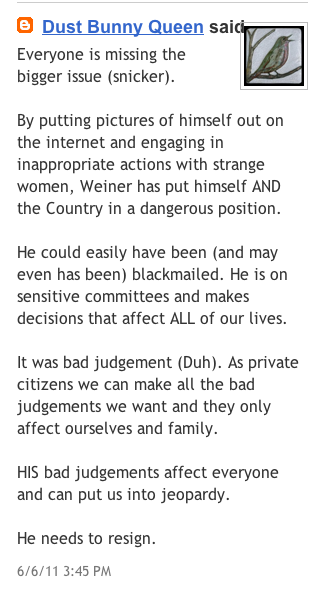
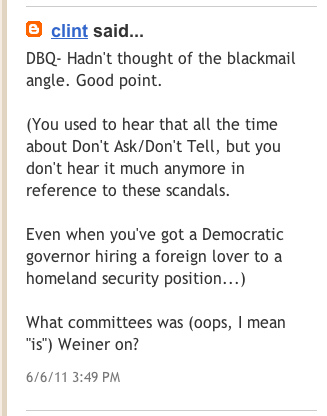
This was brought home in two comments on Ann Althouse’s blog about Weinergate:

These people sit on committees and routinely receive sensitive information. Embarrassment is hard to take(ask Weiner), so if you can avoid embarrassment by lying about your actions or paying someone off or . . .

I have sympathy for him. His apology seemed heartfelt. However, it came about not because he wanted to apology. It came about because he had no other choice. What if he had had another choice? What if he could have made the allegations go away with a little money, a small kickback, a leak? What if?

Panorama Theme by Themocracy